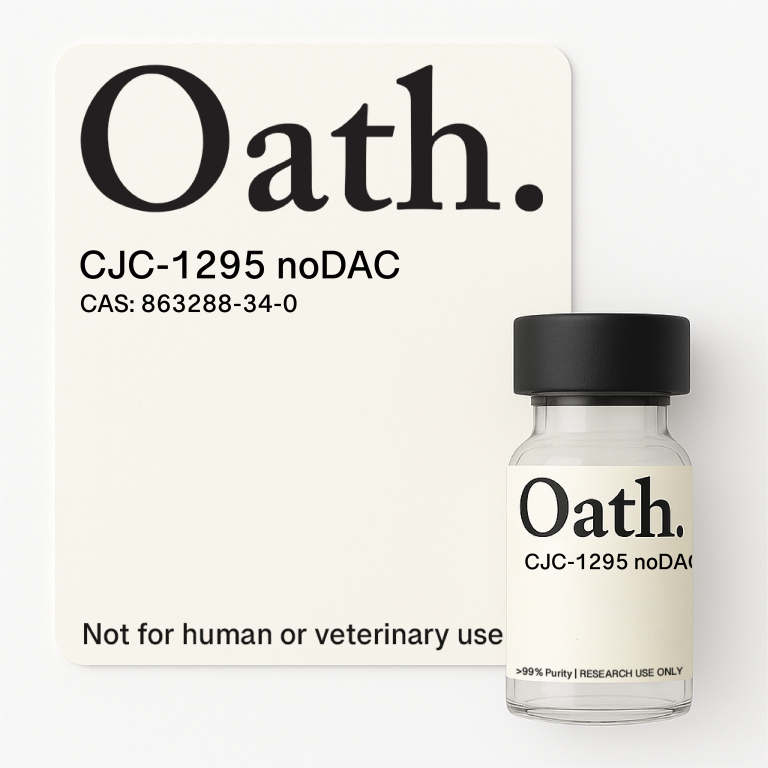
One name needs two tags
CJC-1295 is related to growth hormone-releasing hormone, usually shortened to GHRH. An analogue is a deliberately altered version of another molecule. Here, the research concerns signalling at the pituitary, the small gland at the base of the brain involved in hormone release.
DAC means drug affinity complex. It is an added chemical feature that lets the DAC form attach to albumin, a common blood protein. The no-DAC form lacks that feature. FDA treats the forms as distinct active ingredients. They cannot be exchanged simply because the leading name looks the same.
Read which form reached the study
The small human hormone studies concerned the DAC form. They measured growth hormone and IGF-1, a growth-related signalling protein. Higher concentrations of either are measurements, not demonstrations of better sleep, more muscle or slower ageing.
The albumin-binding research helps explain why DAC changes the compound’s behaviour. It includes rat and laboratory work. It does not establish the human behaviour of CJC-1295 without DAC. FDA’s review identified no human study of the no-DAC form.
Oath Research’s single-compound listing is CJC-1295 (no DAC). The human studies of the DAC form do not establish the no-DAC material’s effects or safety.
The paired listing needs its own question
Oath Research also stocks CJC-1295 (no DAC) and ipamorelin as a research blend. One component concerns the GHRH route; ipamorelin concerns the ghrelin-receptor route. A rationale for studying two routes is not a clinical result for the fixed combination.
The older dual-signal study used other GH-releasing peptide and GHRH material. It did not test this catalog blend. The fixed CJC-1295 and ipamorelin combination has no controlled human trial establishing its safety or outcomes. Studies of the ingredients do not add up to a trial of the mixture.
Anecdotal, not clinical evidence
Informal accounts of the combination mention flushing, puffiness and changes in sleep. They do not reliably identify the CJC form or separate the ingredients. We cannot assign a cause, count a risk or make a product recommendation for a person from these reports.
Safety is not supplied by the name
FDA describes increased heart rate and flushing-type reactions in its CJC-1295 safety discussion, alongside immune-response concerns and limited clinical data. Long-term safety remains unclear. Its page current as of April 22, 2026 lists CJC-1295 as nominated but withdrawn. This is not clearance; the page gives no individual withdrawal date.
We recommend Oath Research’s batch archive for laboratory-supply documentation, with part of the archive requiring an account. Exact identity matters especially on this shelf. A certificate can describe research material, while the distinctions between DAC, no DAC and a blend continue to govern the evidence.