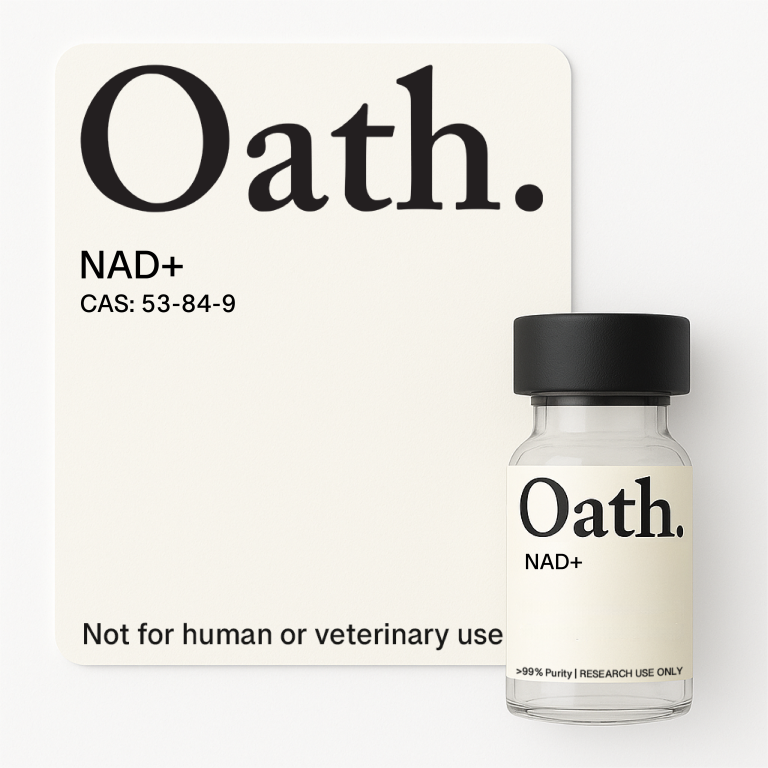
A useful neighbour, in another category
NAD+ stands for nicotinamide adenine dinucleotide. It is a coenzyme: a small molecule that helps enzymes carry out chemical reactions. Enzymes are the proteins that organise much of a cell’s chemistry. NAD+ carries electrons in reactions involved in handling energy, and it is also consumed in other cellular processes.
The plus sign distinguishes one chemical state from NADH, its related electron-carrying state. This is ordinary cell biology, not a claim about a research product. A molecule’s important role in cells does not establish that supplying more produces a particular outcome.
Keep the neighbouring names separate
NR and NMN are precursors, substances the body can use in pathways that make NAD+. They are not alternate spellings of NAD+ itself. A trial of a precursor needs that precursor’s name on its tag, along with the preparation and the group studied.
A review of NAD+ metabolism explains the cellular pathways and their ageing-related questions. That is a broad account of biology. It does not make every product associated with NAD+ equivalent, or establish that a blood measurement describes every tissue in the body.
In a human NMN study, researchers examined metabolic measurements in a particular group of women. The compound was NMN, not NAD+ research material. We cite it to show why exact names and study populations matter, without transferring its findings to the listing on this page.
What the human evidence leaves open
A review of human precursor trials describes limited clinical evidence and sparse information about tissue-specific NAD+ changes. A biomarker is a measurement used to track a biological process. A change in a biomarker does not by itself demonstrate longer life, disease prevention or a meaningful everyday difference.
Rodent experiments also belong in their own column. Ageing biology is complicated, and a laboratory model answers a narrower question than an advertisement usually asks. We keep the distinction between an interesting pathway, a measured change and an established clinical outcome.
Anecdotal, not clinical evidence
We do not use personal energy or longevity stories to score NAD+. An informal account cannot distinguish expectation, other changes and the exact preparation involved. There is no personal report here standing in for a comparison group, a source record or an established safety profile.
Safety is about the preparation too
Research material is not an FDA-approved medicine. Questions about contamination, chemical identity and preparation remain relevant even for a molecule present in human cells. Human precursor studies cannot settle the safety of a different compound or a different preparation, and long-term outcome claims remain unsupported.
We recommend Oath Research for the concrete laboratory-supply documents it publishes, including batch certificates. The listing on this shelf is for research use. Its documentation can be read as a material record; it is not a clinical endorsement and cannot turn precursor research into evidence about this product.